
| Search our quarter-million Q&As |
Home of the finishing HOTLINE since 1989
-----:Hot dip galvanising of S.G. iron products
Quickstart:
In hot dip galvanizing the components to be galvanized are dipped into a kettle of molten zinc (after cleaning and fluxing). The zinc partially alloys with the steel or iron and partially adheres as a coating which hardens as the component is withdrawn and cools.
S.G. iron means spherical graphite iron (ductile iron), a compositional modification to cast iron rendering it more ductile and more corrosion resistant.
Read on, join in ...
Q. Dear Sir,
We are facing very big problems in hot dip galvanising of S.G. iron products.
When we try to dip it into the acid bath zinc doesn't adhere to the surface uniformly, meaning that zinc gets deposited on the surface as patches. There are many bare parts.
What could be be the reason for this and the appropriate solution?
Please guide
Thanks in advance.
plating shop employee - India
August 23, 2008

Never use HF anywhere unless trained!
If you do, you MUST have the antidote gel on hand for instant use!
Calcium Gluconate
for HF acid burns
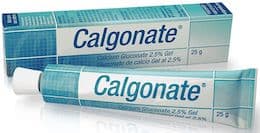
on Amazon or eBay
(affil link)
A. Sir,
I had to "look-up" S G steel on the internet and it seems to be a type of cast iron. About 30 years ago I tried to clean castings using HCl and H2SO4 with little success. Then I tried with HF (hydrofluoric acid) and immediately the sand was removed and deposited on the bottom of the beaker. HF is extremely dangerous and I knew a guy who died from inhaling HF fumes. The glass "face" of his wristwatch was etched.
Some galvanizers use sand or grit blasting to clean castings, however too much blasting can break through the "shell" of the castings into graphite (carbon) rich areas and then the castings will not galvanize.
It is also possible that your flux solution is bad. You did not mention if you are using "wet" or "dry" galvanizing.
Regards,
Galvanizing Consultant - Hot Springs, South Dakota, USA
Q. I don't know about wet or dry hot dip galvanising. It is being done in a zinc bath at a temp of 550 °C. Can you explain this point?
The problem we are facing is that after taking out the product from the bath on some regions of the product sand comes over and no zinc is deposited on the surface. So a part of the product if left bare.
What can be done?
Regards,
- India

|
SUGGESTED GALVANIZING BOOKS
for Engineers, Shops, Specifiers 
avail from eBay, AbeBooks, or Amazon 
avail from eBay, AbeBooks, or Amazon 
avail from eBay, AbeBooks, or Amazon 
avail from eBay, AbeBooks, or Amazon avail from Amazon "User's Guide to Hot Dip Galvanizing for Corrosion Protection in Atmospheric Service" by NACE (1997 only rarely avail.) avail from AbeBooks, or Amazon (as an Amazon Associate & eBay Partner, we earn from qualifying purchases) A. Sir: Galvanizing Consultant - Hot Springs, South Dakota, USA A. Hello Manjeet,  Bill Reynolds [deceased] consultant metallurgist - Ballarat, Victoria, Australia We sadly relate the news that Bill passed away on Jan. 29, 2010. |
Q. Dear Sirs,
Thank you for your responses. If HF is that dangerous we can't use it as it could cause a great problem if some one dies of that.
We have got a sample ready after reading your suggestions. My customer is demanding 700 hours salt spray on that s.g iron product.
I think I have three options
1. Hot - Dip galvanising
2. Zn-Ni plating with passivation
3. Spraying with Magni coatings.
Which one do you suggest to be most economical?
Regards,
- India
A. Hi, Manjeet. A principle reason for choosing S.G. iron is its inherent corrosion resistance. Maybe it doesn't need coating 🙂
Electroplating is more economical than dip-spin coating and much more economical than galvanizing, but 700 hours salt spray is a lot for metallic coatings on castings! It can be difficult to electroplate castings; you probably must use an acid-based zinc-nickel rather than an alkaline one.
Salt spray testing of galvanized coatings is foolish. Although post-dip galvanizing easily outlasts any other coating on steel in most environments -- lasting 50, 75, even a hundred years -- the way it manages this is through a very slow reaction with the carbon dioxide in the atmosphere over months, years, and decades, forming a glassy and corrosion resistant zinc carbonate skin.
Regards,

Ted Mooney, P.E.
Striving to live Aloha
finishing.com - Pine Beach, New Jersey
Need quick confidential answers? $25
Need project assistance? $100/hr.
Sorry! Finishing.com is temporarily Read-Only.
Ted Mooney is retiring but I have several offers to take it over.
We're working hard to make sure we find it the best new home.