
| Search our quarter-million Q&As |
Home of the finishing HOTLINE since 1989
-----Recovery of metals/chemicals from ion exchange resins
I have been performing experiments with ion exchange as R&D for an effluent treatment plant I'm trying to install in my plating shop. The resin absorb ions pretty well, but I have been unable, after numerous tries, been up able to figure how much regenerant is required so the resin can recharge, with excess unused reagent contaminating it.
thank you
plating shop owner - Anand, Gujarat, India
June 11, 2008
June 11, 2008
Hi, Ravi. Ion exchange columns are gradient processes rather than stochiometric processes. I apologize if these aren't exactly the right terms, but I'm trying to say in a shorthand way, and with a graphic that fades from one color to another, that the concentration of metal or acid at one cm into the column is greater than at two cm in, which is greater than at three cm in.
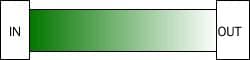
Some columns have a transition zone far shorter than the length of the column, but it's never zero. So I don't think you'll ever find the amount of regenerant that 100 percent recharges the column without "wasting" any regenerant acid or alkali. I think what you do is decide that so much regenerant recharges it to 95 percent or 98 percent of capacity. Additional input from ion exchange experts is welcomed.
Regards,

Ted Mooney, P.E.
Striving to live Aloha
finishing.com - Pine Beach, New Jersey
Need quick confidential answers? $25
Need project assistance? $100/hr.
You have to rinse the ion exchange media very well after regeneration to prevent contamination of your solution.
Ion exchange is an expensive waste treatment method, but is used when you can recover expensive metals like gold or silver or you have very very stringent waste requirements.
- Navarre, Florida
June 12, 2008
Ion exchange can be a very cost effective effluent treatment method, used judiciously.
The best application I've seen for it is in polishing effluent that is just a little out of spec. Instead of adding more coagulants, coprecipitants, etc. that make more sludge, you pass the wastewater, after primary chem treatment, through a bed of Rohm & Haas IRC
718, or an equivalent product. This is a chelating resin that has a selective affinity for transition metals, which regulated metals tend to be. It will not pick up ions such as Na, Ca, and Mg.
Granted, there is a two stage regen cycle (the resin must be treated with acid, then brine to bring it back to the sodium form used in the service cycle) but the mass loading of metal is so low that you don't have to do that often.

Dave Wichern
Consultant - The Bronx, New York
June 16, 2008
Sorry! Finishing.com is temporarily Read-Only.
Please maintain your bookmarks! Although Ted Mooney is retiring, finishing.com is not!
It will have a new owner/curator very shortly!