
 mobile?
Metal finishing Q&As since 1989
-----
Anodizing different alum. types-causes changes in finish
I have been anodizing for a few years in a small in house shop. we do 99% aluminum 2024 & 5052. here recently one of our jobs has been plating an extruded angle from 6061-t6. we are plating them using the same processes as before, but our results are totally different. the parts do not have any streaking as read in some of the other postings, but are a dull dark grey vs. the usual light alum color. what are we doing wrong? or is this a normal problem? thanks....
Martin Bakersmall in house anodizer - Sweetwater, Texas
2006
What you are seeing is entirely normal. The anodised colour is different because of the different alloying elements used. I think the main thing causing a difference in your situation is the amount of Silicon in the alloy. 2024 contains 0.15%, 5052 0.25% and 6061 0.4-0.8% Si. This difference is enough to give your 6061 anodising a darker grey colour than you would get with the other two alloys.
John Reid- Brisbane, Qld, Australia
2006
Let us know the acid purity, acid strength in grams per liter, anodizing temperature, anodizing current density, starting surface finish, cathode material, surface preparation - then we will make some suggestions.

Robert H Probert
Robert H Probert Technical Services

Garner, North Carolina

2006
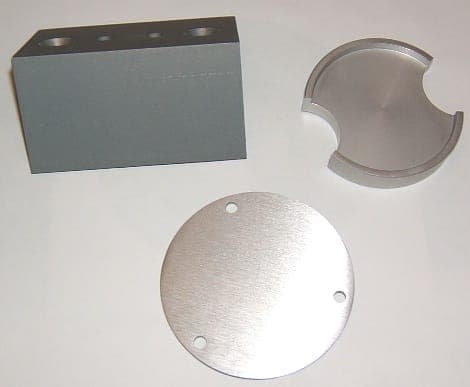
Angle is 6061; round parts are 2021
2006
Acid purity ù industrial
Acid strength ù 15% by weight
Anodizing temp ù room temp. non-heated (80-110F)
Anodizing current density- unknown - fixed
battery charger [on
eBay or
Amazon (adv.)]
12v
Starting surface finish- unknown (sanded finish)
Cathode material- lead
Surface preparation- sanded then washed with
lacquer thinner [on
eBay or
Amazon (adv.)].
- Sweetwater, Texas
The 2000 material is less conductive and requires more voltage to get the same amperage. Obviously your current density is lower on the 2024 so the color is different. You will have to control the voltage and current accurately to get the same color. YOu can raise the acid strength up to 16 or 17%/weight and partially get the colors closer together, but the best way is to go get a rectifier with meters and control.
Robert H Probert
Robert H Probert Technical Services
Garner, North Carolina
2006
Q, A, or Comment on THIS thread -or- Start a NEW Thread